 Official Website of the Government of Barbados


Climate Change and Poultry Production
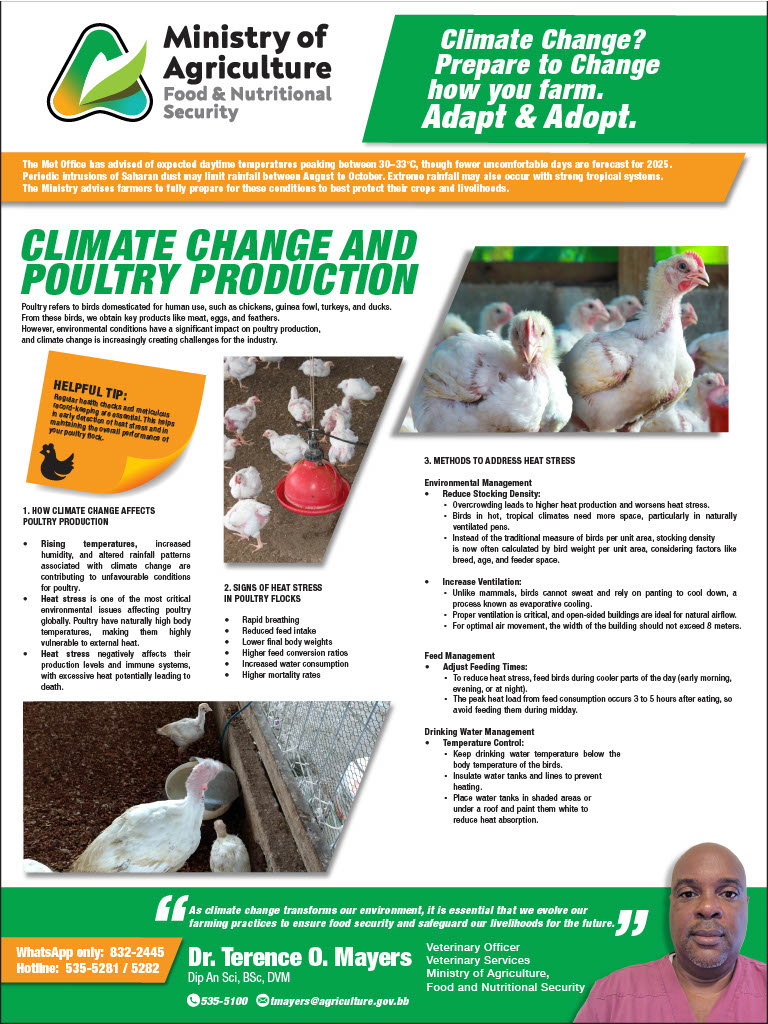
The Met Office has advised of expected daytime temperatures peaking between 30–33°C, though fewer uncomfortable days are forecast for 2025. Periodic intrusions of Saharan dust may limit rainfall between August to October. Extreme rainfall may also occur with strong tropical systems. The Ministry advises farmers to fully prepare for these conditions to best protect their crops and livelihoods.
Poultry refers to birds domesticated for human use, such as chickens, guinea fowl, turkeys, and ducks. From these birds, we obtain key products like meat, eggs, and feathers. However, environmental conditions have a significant impact on poultry production, and climate change is increasingly creating challenges for the industry.
HOW CLIMATE CHANGE AFFECTS POULTRY PRODUCTION
- Rising temperatures, increased humidity, and altered rainfall patterns associated with climate change are contributing to unfavourable conditions for poultry.
- Heat stress is one of the most critical environmental issues affecting poultry globally. Poultry have naturally high body temperatures, making them highly vulnerable to external heat.
- Heat stress negatively affects their production levels and immune systems, with excessive heat potentially leading to death.
SIGNS OF HEAT STRESS IN POULTRY FLOCKS
- Rapid breathing
- Reduced feed intake
- Lower final body weights
- Higher feed conversion ratios
- Increased water consumption
- Higher mortality rates
MANAGEMENT OF HEAT STRESS IN POULTRY FLOCKS
Environmental Management
- Reduce Stocking Density:
- Overcrowding leads to higher heat production and worsens heat stress.
- Birds in hot, tropical climates need more space, particularly in naturally ventilated pens.
- Instead of the traditional measure of birds per unit area, stocking density is now often calculated by bird weight per unit area, considering factors like breed, age, and feeder space.
- Increase Ventilation:
- Unlike mammals, birds cannot sweat and rely on panting to cool down, a process known as evaporative cooling.
- Proper ventilation is critical, and open-sided buildings are ideal for natural airflow.
- For optimal air movement, the width of the building should not exceed 8 meters.
Feed Management
- Adjust Feeding Times:
- To reduce heat stress, feed birds during cooler parts of the day (early morning, evening, or at night).
- The peak heat load from feed consumption occurs 3 to 5 hours after eating, so avoid feeding them during midday.
Drinking Water Management
- Temperature Control:
- Keep drinking water temperature below the body temperature of the birds.
- Insulate water tanks and lines to prevent heating.
- Place water tanks in shaded areas or under a roof and paint them white to reduce heat absorption.
HELPFUL TIP: