 Official Website of the Government of Barbados


Climate Change and Pig Production
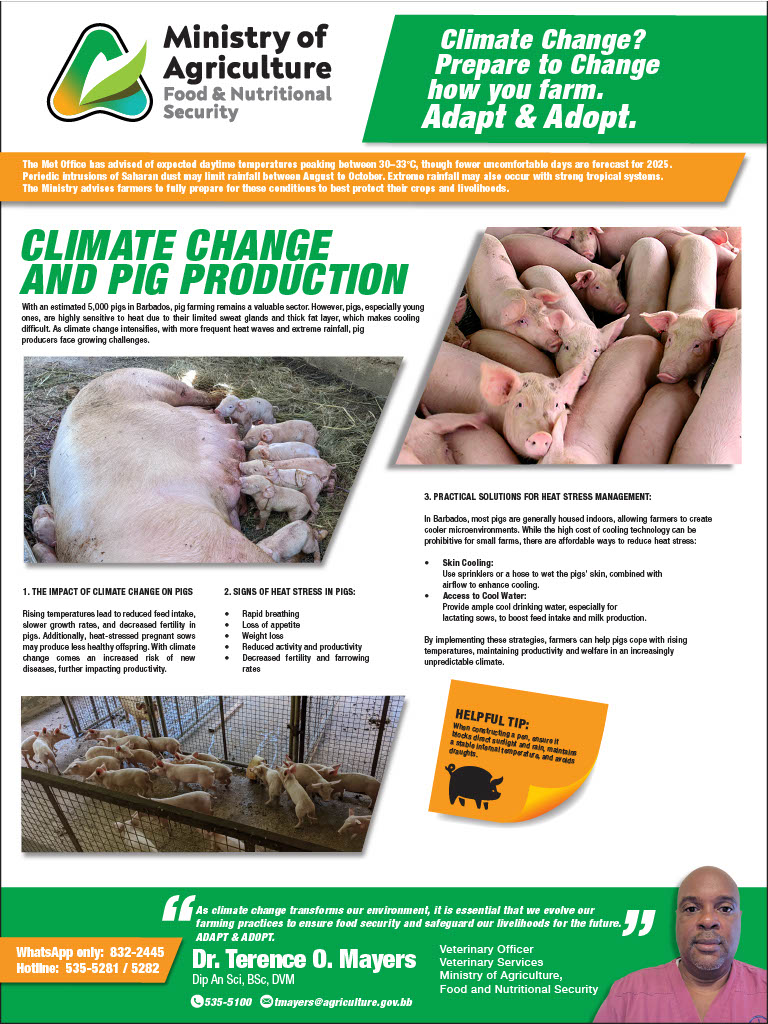
The Met Office has advised of expected daytime temperatures peaking between 30–33°C, though fewer uncomfortable days are forecast for 2025. Periodic intrusions of Saharan dust may limit rainfall between August to October. Extreme rainfall may also occur with strong tropical systems. The Ministry advises farmers to fully prepare for these conditions to best protect their crops and livelihoods.
With an estimated 5,000 pigs in Barbados, pig farming remains a valuable sector. However, pigs, especially young ones, are highly sensitive to heat due to their limited sweat glands and thick fat layer, which makes cooling difficult. As climate change intensifies, with more frequent heat waves and extreme rainfall, pig producers face growing challenges.
THE IMPACT OF CLIMATE CHANGE ON PIGS
Rising temperatures lead to reduced feed intake, slower growth rates, and decreased fertility in pigs. Additionally, heat-stressed pregnant sows may produce less healthy offspring. With climate change comes an increased risk of new diseases, further impacting productivity.
SIGNS OF HEAT STRESS IN PIGS
- Rapid breathing
- Loss of appetite
- Weight loss
- Reduced activity and productivity
- Decreased fertility and farrowing rates
PRACTICAL SOLUTIONS FOR HEAT STRESS MANAGEMENT
In Barbados, most pigs are generally housed indoors, allowing farmers to create cooler microenvironments. While the high cost of cooling technology can be prohibitive for small farms, there are affordable ways to reduce heat stress:
- Skin Cooling:
Use sprinklers or a hose to wet the pigs' skin, combined with airflow to enhance cooling.
- Access to Cool Water:
Provide ample cool drinking water, especially for lactating sows, to boost feed intake and milk production.
By implementing these strategies, farmers can help pigs cope with rising temperatures, maintaining productivity and welfare in an increasingly unpredictable climate.
HELPFUL TIP:
When constructing a pen, ensure it blocks direct sunlight and rain, maintains a stable internal temperature, and avoids draughts.
WhatsApp only: 832-2445
Hotline: 535-5281 / 5282
“As climate change transforms our environment, it is essential that we evolve our farming practices to ensure food security and safeguard our livelihoods for the future. ADAPT & ADOPT.”