 Official Website of the Government of Barbados


Climate Change and Fruit Crops
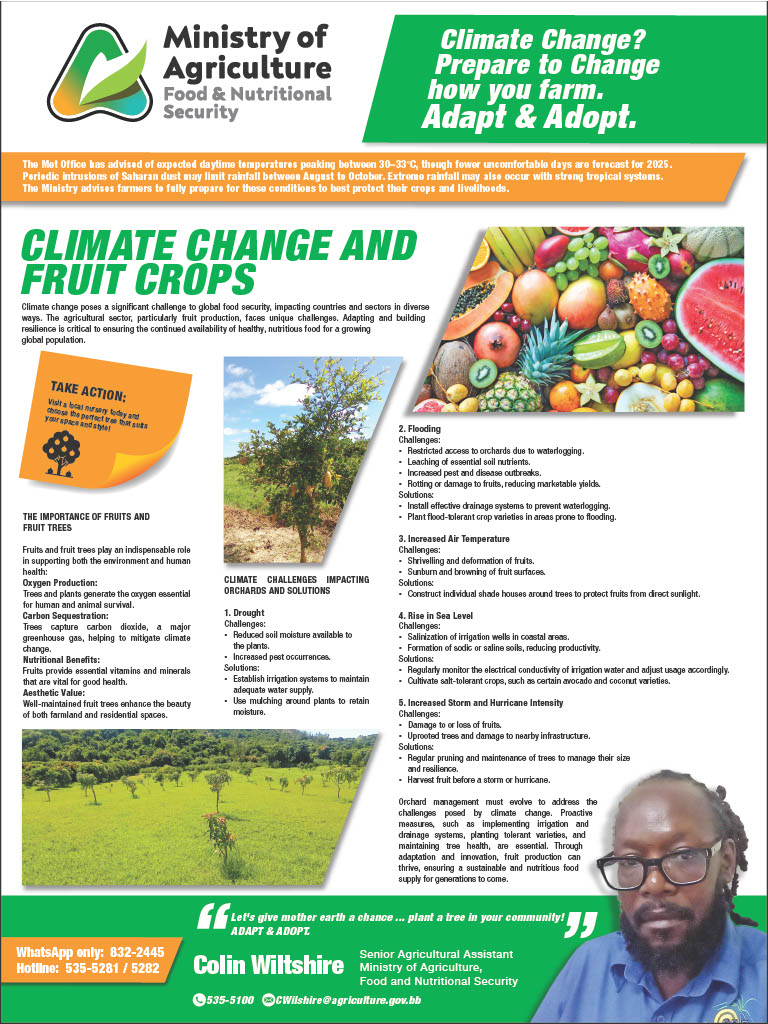
The Met Office has advised of expected daytime temperatures peaking between 30–33°C, though fewer uncomfortable days are forecast for 2025. Periodic intrusions of Saharan dust may limit rainfall between August to October. Extreme rainfall may also occur with strong tropical systems. The Ministry advises farmers to fully prepare for these conditions to best protect their crops and livelihoods.
Climate change poses a significant challenge to global food security, impacting countries and sectors in diverse ways. The agricultural sector, particularly fruit production, faces unique challenges. Adapting and building resilience is critical to ensuring the continued availability of healthy, nutritious food for a growing global population.
THE IMPORTANCE OF FRUITS AND FRUIT TREES
Fruits and fruit trees play an indispensable role in supporting both the environment and human health:
- Oxygen Production:
Trees and plants generate the oxygen essential for human and animal survival.
- Carbon Sequestration:
Trees capture carbon dioxide, a major greenhouse gas, helping to mitigate climate change.
- Nutritional Benefits:
Fruits provide essential vitamins and minerals that are vital for good health.
- Aesthetic Value:
Well-maintained fruit trees enhance the beauty of both farmland and residential spaces.
CLIMATE CHALLENGES IMPACTING ORCHARDS AND SOLUTIONS
- Drought
Challenges:
- Reduced soil moisture available to the plants.
- Increased pest occurrences.
Solutions:
- Establish irrigation systems to maintain adequate water supply.
- Use mulching around plants to retain moisture.
- Flooding
Challenges:
- Restricted access to orchards due to waterlogging.
- Leaching of essential soil nutrients.
- Increased pest and disease outbreaks.
- Rotting or damage to fruits, reducing marketable yields.
Solutions:
- Install effective drainage systems to prevent waterlogging.
- Plant flood-tolerant crop varieties in areas prone to flooding.
- Increased Air Temperature
Challenges:
- Shrivelling and deformation of fruits.
- Sunburn and browning of fruit surfaces.
Solutions:
- Construct individual shade houses around trees to protect fruits from direct sunlight.
- Rise in Sea Level
Challenges:
- Salinization of irrigation wells in coastal areas.
- Formation of sodic or saline soils, reducing productivity.
Solutions:
- Regularly monitor the electrical conductivity of irrigation water and adjust usage accordingly.
- Cultivate salt-tolerant crops, such as certain avocado and coconut varieties.
- Increased Storm and Hurricane Intensity
Challenges:
- Damage to or loss of fruits.
- Uprooted trees and damage to nearby infrastructure.
Solutions:
- Regular pruning and maintenance of trees to manage their size and resilience.
- Harvest fruit before a storm or hurricane.
Orchard management must evolve to address the challenges posed by climate change. Proactive measures, such as implementing irrigation and drainage systems, planting tolerant varieties, and maintaining tree health, are essential. Through adaptation and innovation, fruit production can thrive, ensuring a sustainable and nutritious food supply for generations to come.
TAKE ACTION:
Visit a local nursery today and choose the perfect tree that suits your space and style!
WhatsApp only: 832-2445
Hotline: 535-5281 / 5282
“Let's give mother earth a chance ... plant a tree in your community. ADAPT & ADOPT.”
Colin Wiltshire
Senior Agricultural Assistant
Ministry of Agriculture, Food Tony Rawlins and Nutritional Security
T: 535-5100
E: CWilshire@agriculture.gov.bb